
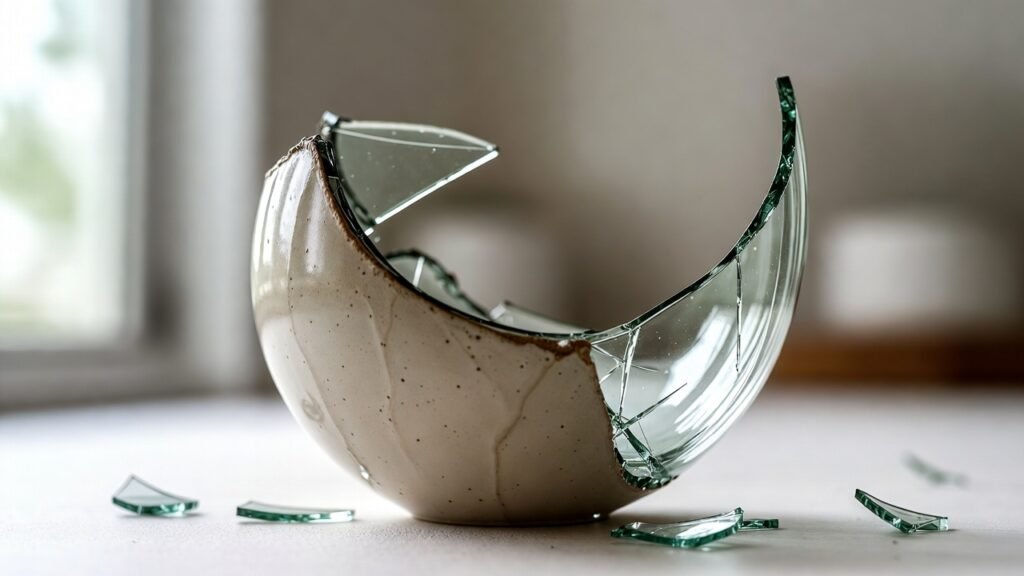
Broken, But Beautiful.
The tears flowed endlessly.
Eve was overwhelmed.
She stood frozen, staring at the broken pieces of the vase scattered across the floor. Once whole. Once exquisite. A gift from her father twelve years ago chosen with intention, wrapped with care, handed to her with words she still remembered: “This is strong, just like you.”
Now it lay shattered. Too many pieces to count. Sharp edges catching the light.
“Why am I so clumsy?” she muttered, her voice heavy with accusation.
“I do this everywhere I go.”
Her mind raced ahead of her body, as it often did.
……. Bumping into people. Knocking over chairs. Speaking before her turn or disappearing into silence when her voice mattered most. Social gatherings left her exhausted, replaying every moment on the drive home.
“I can’t even keep a job for two years,” she whispered.
And just like that, the spiral began.
Her thoughts stacked themselves neatly into a story she knew too well:
I am the problem. I ruin things. I don’t fit. I break what matters.
She slid down onto the floor beside the vase, careful now—ironically gentle—as if the fragments might feel her regret.
For a long time, she sat there.
Then something shifted.
Not a miracle. Not clarity. Not relief. Just a pause.
She picked up one piece. Then another. Some were jagged. Some smooth. Some impossibly small. She noticed that none of them were identical, yet each still carried the same glaze, the same color, the same story.
And a quiet thought interrupted the noise:
What if this isn’t proof that I destroy beautiful things?
What if this is proof that something beautiful existed, and still does?
Eve remembered a concept she once learned but never truly absorbed: brokenness is not the opposite of worth.
She had spent years interpreting struggle as failure. Sensitivity as weakness. Inconsistency as incompetence. She had judged herself harshly for the very adaptations that helped her survive pressure, expectation, and exhaustion.
She realized how often she treated her struggles as personal failures instead of human experiences.
Her sensitivity.
Her racing thoughts.
Her pauses and bursts.
Her starts and restarts.
These were not moral flaws. They were signals. Messages. Adaptations formed through survival, stress, love, loss, and hope.
She gathered the pieces carefully, placing them into a box, not to hide them, but to hold them.
The next morning, sunlight poured through the window and landed on the fragments. Something unexpected happened. The cracks reflected the light differently. Softer. Warmer. More alive than before.
Eve did not rush to glue the vase back together.
Instead, she asked new questions.
What parts of me am I trying to erase instead of understand?
What if my scars are not defects but designs shaped by experience?
What would it look like to rebuild slowly, intentionally, compassionately?
She learned this: healing is not about returning to who you were before life happened. It is about becoming someone who can carry what life has given you—without shame.
And so, she began again.
Not perfectly.
Not quickly.
But honestly.
She learned to name her overwhelm before it swallowed her.
To ask for support without apology.
To rest without earning it.
To see her pauses not as failures, but as wisdom.
The vase, once reassembled, would never look the same. Neither would she.
But both would be stronger at the seams. Marked, intentional, and undeniably beautiful.
Learning from the Cracks
As the year ends, many people find themselves reflecting on regrets, unfinished goals, and moments that did not unfold as planned. This can bring clarity, but it can also promote self-criticism, exhaustion, and emotional fatigue.
This reflection is not an invitation to fix yourself. It is an invitation to pause.
Before setting new goals, take a moment to understand what this outgoing year revealed about your needs, limits, and values. Reflection is a critical component of emotional wellbeing and self-compassion.
Consider these gentle questions as part of your year-end mental health check-in:
- What moments from this year have you labeled as “failures,” when they may be ‘’information’’?
These moments often reveal boundaries, stress points, or unmet needs. - Where did you demand perfection instead of compassion from yourself?
Chronic self-criticism is a known contributor to burnout and emotional distress. - Which parts of you endured something difficult this year?
Survival itself is evidence of strength, even when outcomes were not ideal. - What are you carrying into the new year that no longer requires punishment, only understanding?
At PERAmind Health & Education, we believe sustainable wellbeing is rooted in self-honesty, reflection, and care—not urgency or reinvention.
Before you rebuild, pause.
Before you resolve, reflect.
Before you rush forward, gather the pieces with intention.
Some cracks would remain visible. That is not a weakness. That is design.
As this year ends, take one quiet moment to name what the year taught you, not what it took from you. This awareness is often the first step toward healing, resilience, and meaningful change.
Written By Bukola Oladimeji, RN (Founder, Peramind Health and Education)